Achilles
If Achilles was a real person, then he probably looked something like this.
Around 32 years old at the final year of the Trojan War, his clothing, hair, and equipment are those of the typical bronze age Greek youth that we so often encounter in the half-burned frescoes and painted pottery of the Mycenaean palatial centers. He lived during the last days of an era of unprecedented societal sophistication, vast trade networks, and intricate international diplomacy, and died in one of the many wars that ended it.
He wears a linen kilt, with fringes that indicate his important rank among the Myrmidons. His sword hangs from his shoulder, in a way similar to that depicted in Late Helladic pottery, as well as that of the various marauders of Greek, Anatolian, and unknown origin that can be seen in the walls of the mortuary temple of Ramesses III at Medinet Habu. The same is true for his helmet, which Homer describes as fitting his temples perfectly, fitted with a waving golden plume, and four horns to terrify his enemies.
His greaves are described as being made of tin plates, probably stitched on hardened linen, like those depicted in many bronze age Greek frescoes.
He wields his father's famous spear of Pelian ash wood, which only he can lift. His famous shield, depicting scenes of peace and war, is made of a layer of bronze covering several layers of hide on top of a wooden frame. Its circular shape had become common in the Eastern Mediterranean during the last century of the bronze age. It is decorated with gold, tin, silver, and enamel, and it is attached to a decorated leather shoulder belt. I will make a second post for the shield itself since its symbolism in the epic is very fascinating.
His men have helmets and shields shaped like those found in many Late Helladic depictions of soldiers and naval battles. Some of them who are of higher rank wear boar tusk helmets.
I used primarily references from the late 13th and early 12th centuries BCE, which is the time period in which the poems are set, and I gave priority to artifacts that are closer to Phthia and Mount Pelion, as well as the Sporades islands, all of them places in which Achilles lived and trained.
Some 3200 years after his time, Achilles is still famous for his wild rage, but most importantly, for his final letting go of it.
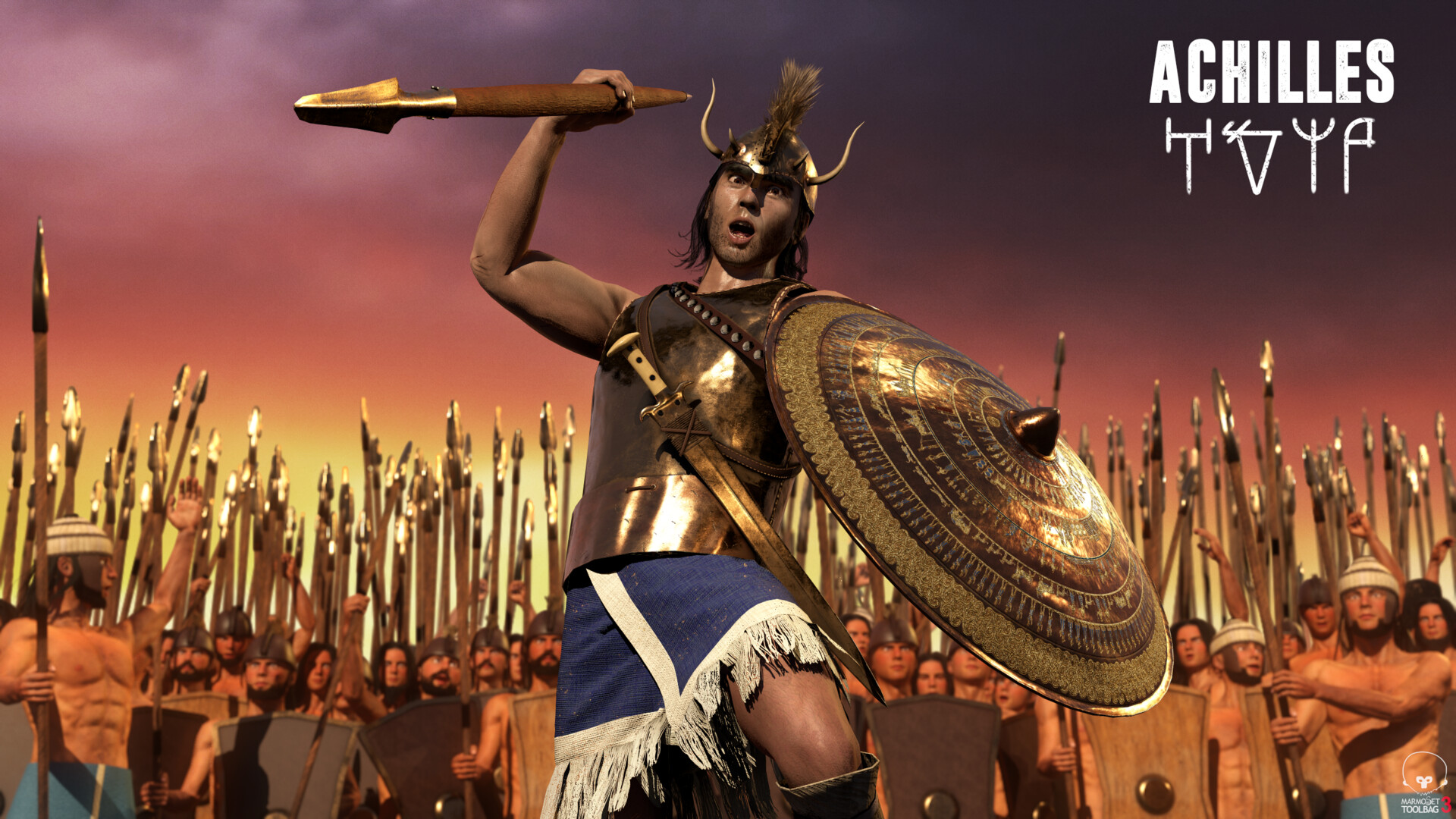
"Rage, Goddess. Sing of the rage of Peleus' son, Achilles..."
~Homer c.800 BCE

Achilles' spear was from Mount Pelion, so I used a spearhead from there. He wears his sword in a way that was common at the time, attested in Mycenaean pottery as well as the famous Battle of the Delta frieze in Ramesses III's Medinet Habu temple.

According to Homer, Achilles' helmet had a crest that ran along its entire ridge, a common element in the warrior depictions of Late Helladic pottery, including one from Iolkos which is close to where Achilles was born and raised.

For Achilles' armor, I used a typical Greek breastplate found in the ruins of bronze age Cadmea in Thebes. These cuirasses had holes for strapping on extra plates to cover the groin area. The Dendra panoply is a great example of this practice.
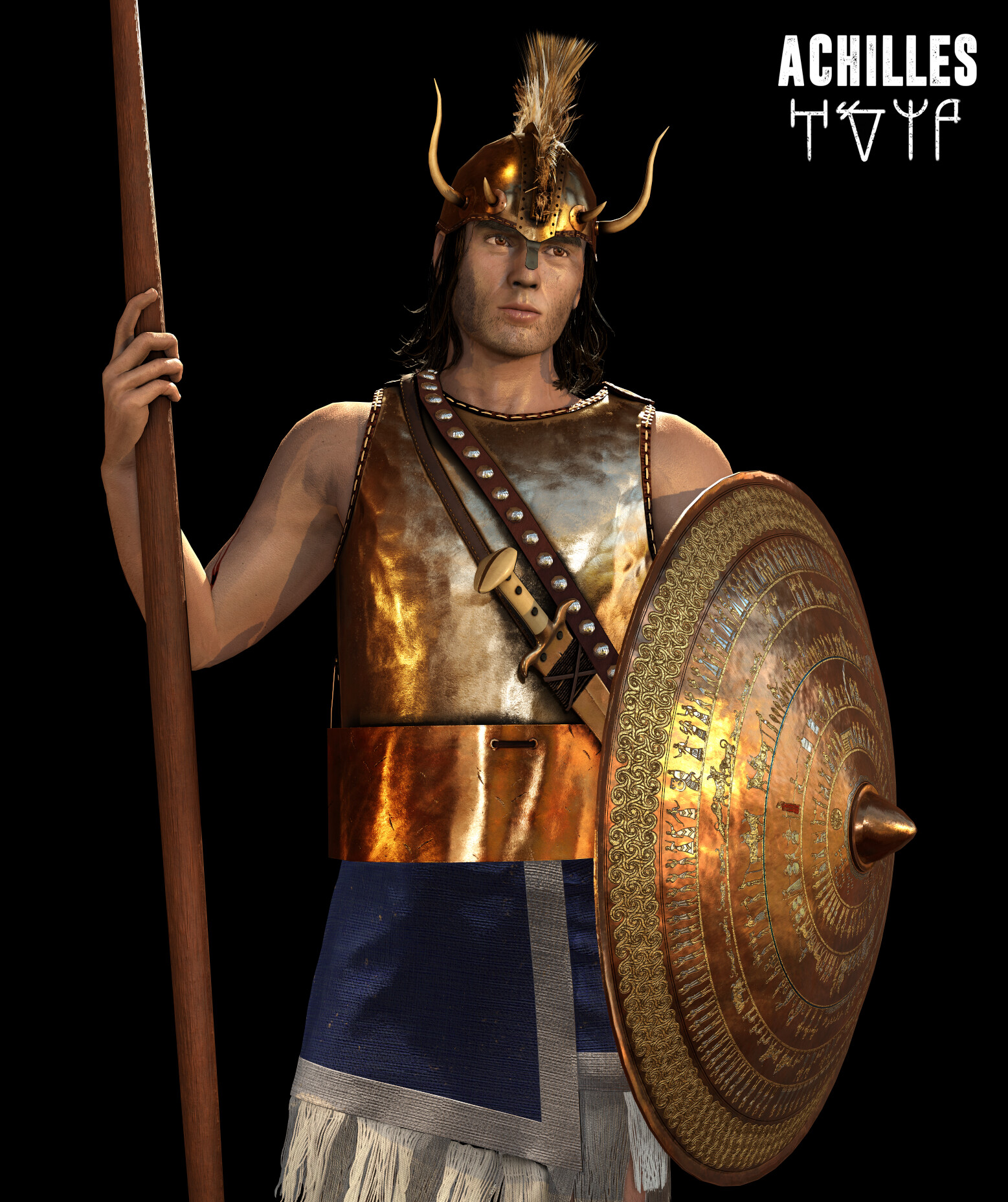
The belt attached to Achilles' shield (telamon in Greek) was decorated with silver according to the Iliad.

I will dedicate an entirely different post to the shield since there is a lot to analyze!

Turnaround.

Some visual references I used for Achilles' look.